
Nine Days in August: The Biggest Buyouts Have Stopped Using Debt
The two largest software take-privates of this cycle are being underwritten on equity rather than leverage — and the vintage that was underwritten on leverage is being handed to its creditors. Both moved inside nine days this month. Taken together, they are the clearest repricing of sponsor capital structure since the last credit cycle turned.
The nine days
August 4. Electronic Arts closed its $55 billion take-private, the largest leveraged buyout on record. The Public Investment Fund holds 93.4% of the equity, Silver Lake 5.5%, Affinity Partners 1.1%. Shareholders received $210 per share, a 25% premium. Approximately $20 billion of the total consideration was funded with debt.
August 13. Reuters reported Silver Lake in discussions to take Workday private at more than $50 billion. The stock closed up nearly 19%, its best session since 2016, at a market capitalization near $51 billion. The talks are preliminary and nothing is signed.
The same sponsor, twice, in nine days. In neither case is the purchase price the interesting figure. The sources and uses are.
While those two structures were being assembled predominantly out of equity, sponsors holding the 2021 vintage were handing portfolio companies to their lenders.
Medallia: the round trip, completed
Start with the case that has already run its course.
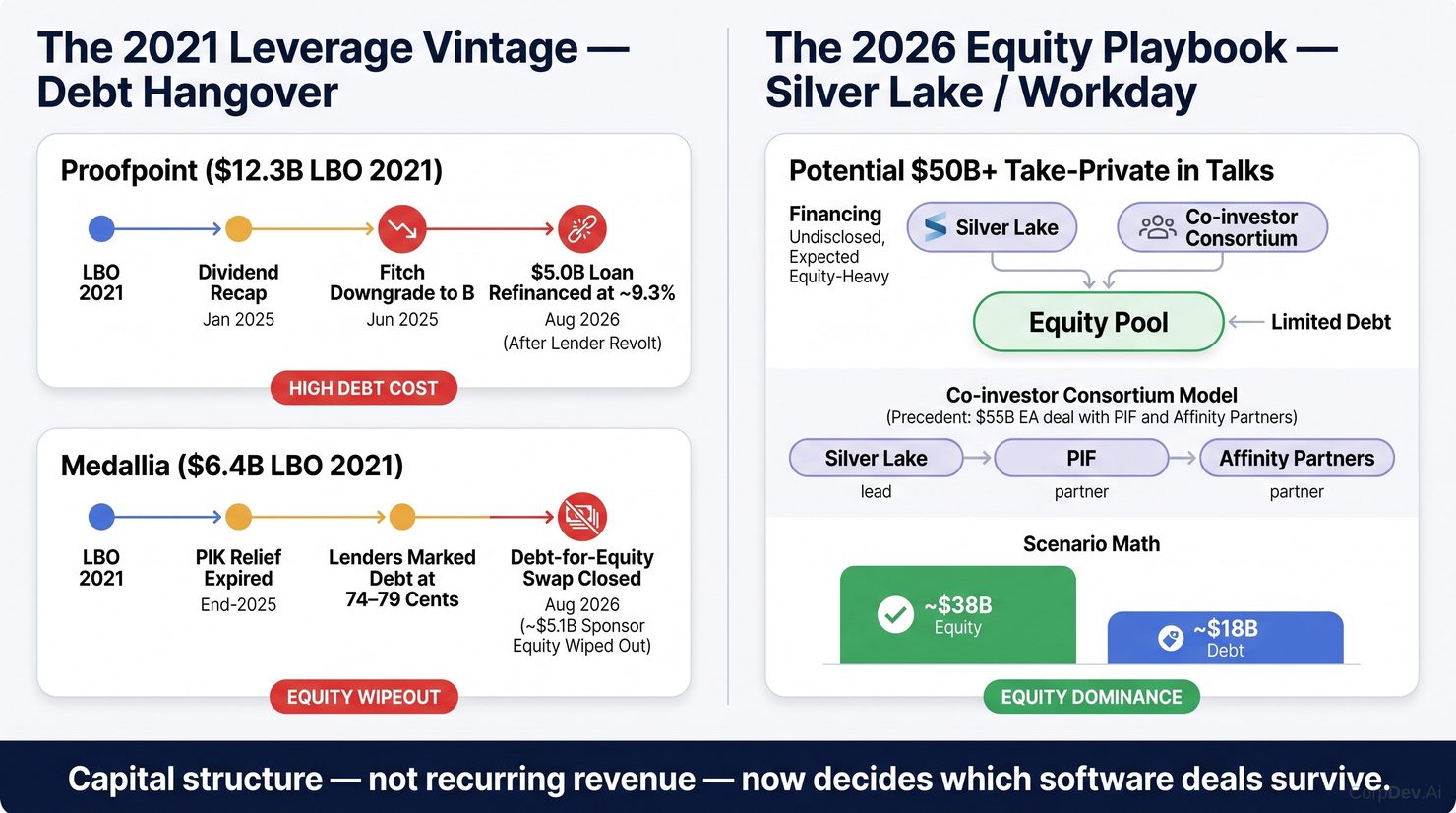
Thoma Bravo acquired Medallia for approximately $6.4 billion in 2021. By 2025 the credit was running on a PIK toggle — capitalizing a portion of its interest rather than servicing it in cash. PIK is routinely marketed as flexibility. It is more accurately a deferral: principal compounds while the underlying problem, too much leverage against too little growth, goes unaddressed.
The relief had a termination date, and it arrived. PIK relief expired at the end of 2025, and the December marks recorded what the lender group actually thought: Blackstone Secured Lending at 77.75, FS KKR near 79, Apollo near 74. In April 2026 the Blackstone-led group declined to extend, which left the sponsor two options — write a materially larger equity check, or hand over the keys.
It wrote a small one. The $75 million equity cure was neither large enough nor early enough. On June 17 the recapitalization was announced: roughly $3 billion of debt exchanged for control, total debt reduced by more than 60%, $150 million of new money committed. It closed on August 3. Approximately $5.1 billion of sponsor and co-invest equity was written off — about four-fifths of the original purchase price.
The precedent traveled faster than the transaction. Offered the choice between another extension and the collateral, the lender group took the collateral. Every sponsor now negotiating PIK relief negotiates against that outcome.
Proofpoint: you don’t have to fail to get punished
Medallia at least had something wrong with it. Proofpoint didn’t, which is why it’s the more useful story.
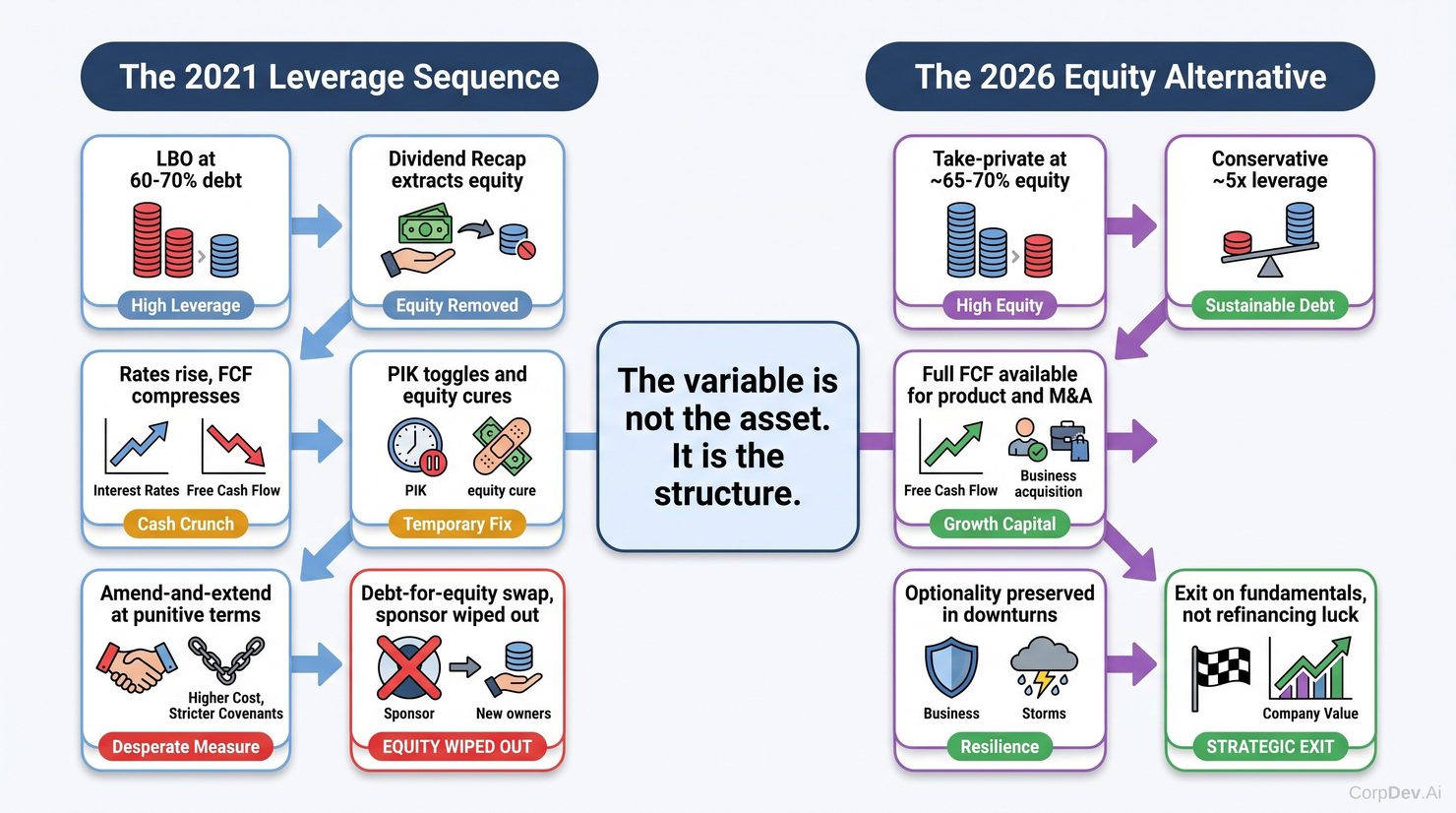
Thoma Bravo took it private for $12.3 billion in August 2021, putting up about $8 billion of its own money against roughly $4 billion of debt. Two-thirds equity. Nobody in 2021 would have called that reckless.
Then it held the company a long time. In January 2025 it borrowed another billion or so to pay itself a dividend. S&P recalculated the leverage at about seven times earnings, and Moody’s put the company on negative outlook. Five months later Proofpoint bought Hornetsecurity for $1.6 billion, borrowing again to do it, and total debt reached roughly $4.67 billion. Fitch cut the rating.
This summer Proofpoint asked its lenders for something fairly ordinary: push $5 billion of loans due in 2028 out to 2030. In a normal year that’s a phone call. Instead the lenders organised. They said yes eventually, but only after Thoma Bravo agreed to about two dozen new restrictions, and only at a rate near 9.3%. It had been paying roughly three points over the benchmark.
Proofpoint never missed a payment. S&P expected it to throw off more than $200 million of cash this year. The lenders weren’t reacting to the business. They were reacting to the dividend, and both rating agencies said so in plain terms.
The restrictions are the part worth watching. The lenders didn’t just charge more — they took away the tools sponsors have spent three years using to manage their way out of trouble. Those clauses are going into loan after loan now.
It isn’t private equity that’s the problem
Truist publishes a running sheet of what about 150 private-equity-owned technology loans actually trade at, and the July 31 edition is the most useful document I’ve read this year. Three things frame it: no new software buyout has been financed in the public loan market since the AI selloff in January, a wall of loans comes due in 2027 and 2028, and anyone who can borrow at all is paying rates that would have looked absurd in 2021.
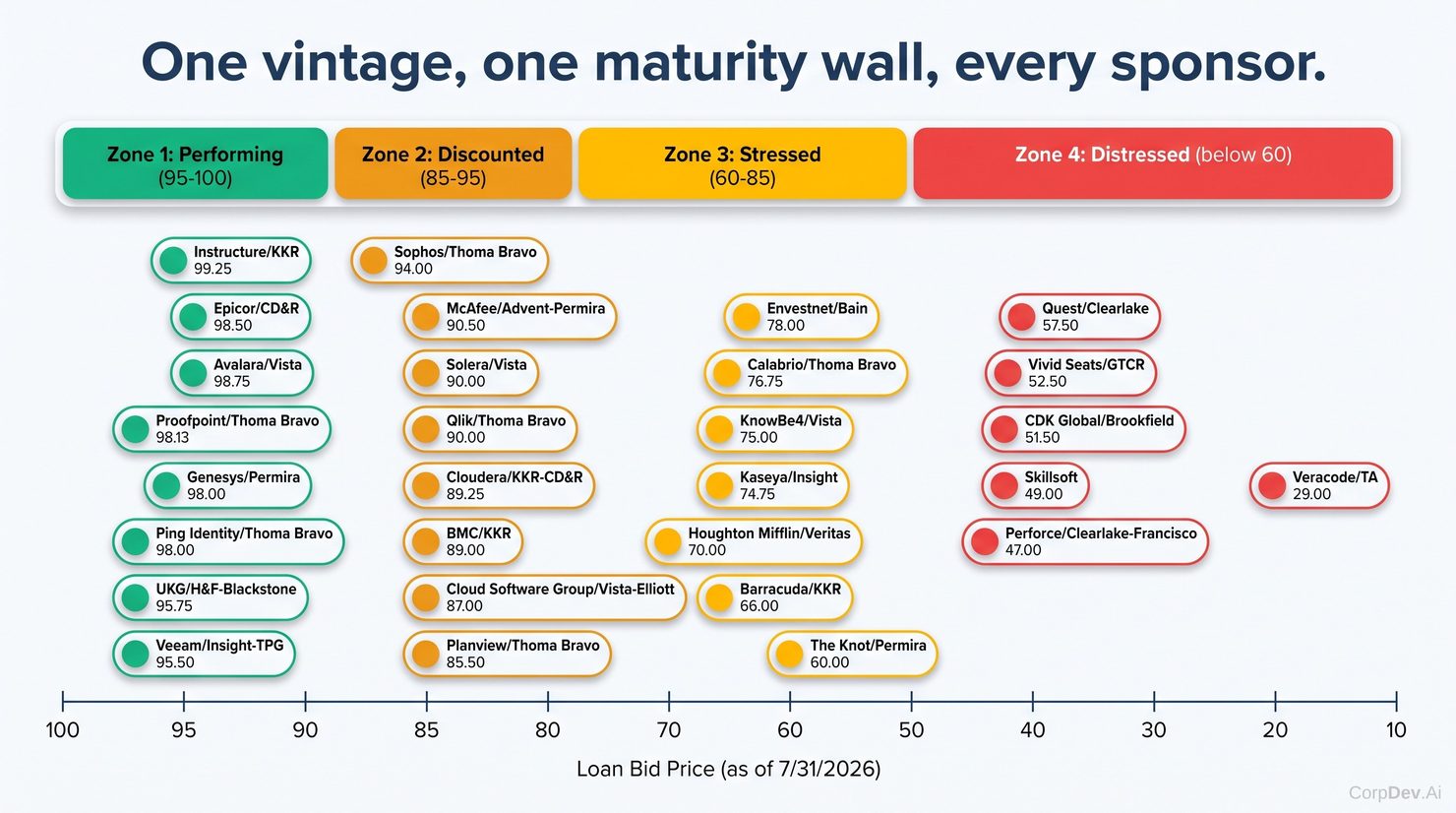
The range is what gets you. Instructure at 99.25 cents on the dollar, Epicor at 98.50, UKG at 95.75, Veeam at 95.50 — all perfectly healthy. Then Solera at 90, yielding 13.67%, with two of its lenders having hired lawyers and agreed to act together ahead of $5 billion coming due, which is more or less what Medallia looked like a year from the end. Sophos at 94, yielding over 17%, with its loans due in March 2027, sooner than anyone else’s. And at the bottom, Veracode at 29 cents, yielding almost 34%.
Same industry, same lenders, ninety-nine cents down to twenty-nine.
So this isn’t a verdict on private equity owning software. It’s a verdict on four specific things, wherever they turn up and whoever owns them: paying 2021 prices, borrowing to pay yourself a dividend, owning something AI might eat, and having loans due in 2027 or 2028. The one I’d most like to see and can’t is Zendesk — about $5 billion of debt against a business that charges by the seat for customer support, and no public price on it at all. That silence isn’t reassuring.
What EA and Workday did differently
Here’s the arithmetic, which is really the whole argument.
EA borrowed about $20 billion against a $55 billion price. Roughly a third debt, two-thirds equity.
Workday, if it happens on the terms Breakingviews sketched: $227 a share, about a 30% premium, funded with something like $38 billion of equity and $18 billion of debt. Call it a $56 billion deal, a third of it borrowed, with the debt at about five times earnings.
Five times earnings, on a company like Workday, isn’t aggressive. By 2021 standards it’s boring. Proofpoint started life at roughly twenty-six times.
Workday would also go into this in good shape: a billion-dollar credit line it hasn’t touched, plenty of cash coming in, more than 11,500 customers, and an AI product it’s selling rather than defending against.
So there’s the experiment. Same kind of company, same kind of buyer, five years apart. What changed isn’t the businesses — Proofpoint and Medallia are real companies with real customers. What changed is how they were paid for.
If you’re holding one of these, here’s the menu
Seven ways out, and they get more expensive the longer you wait.
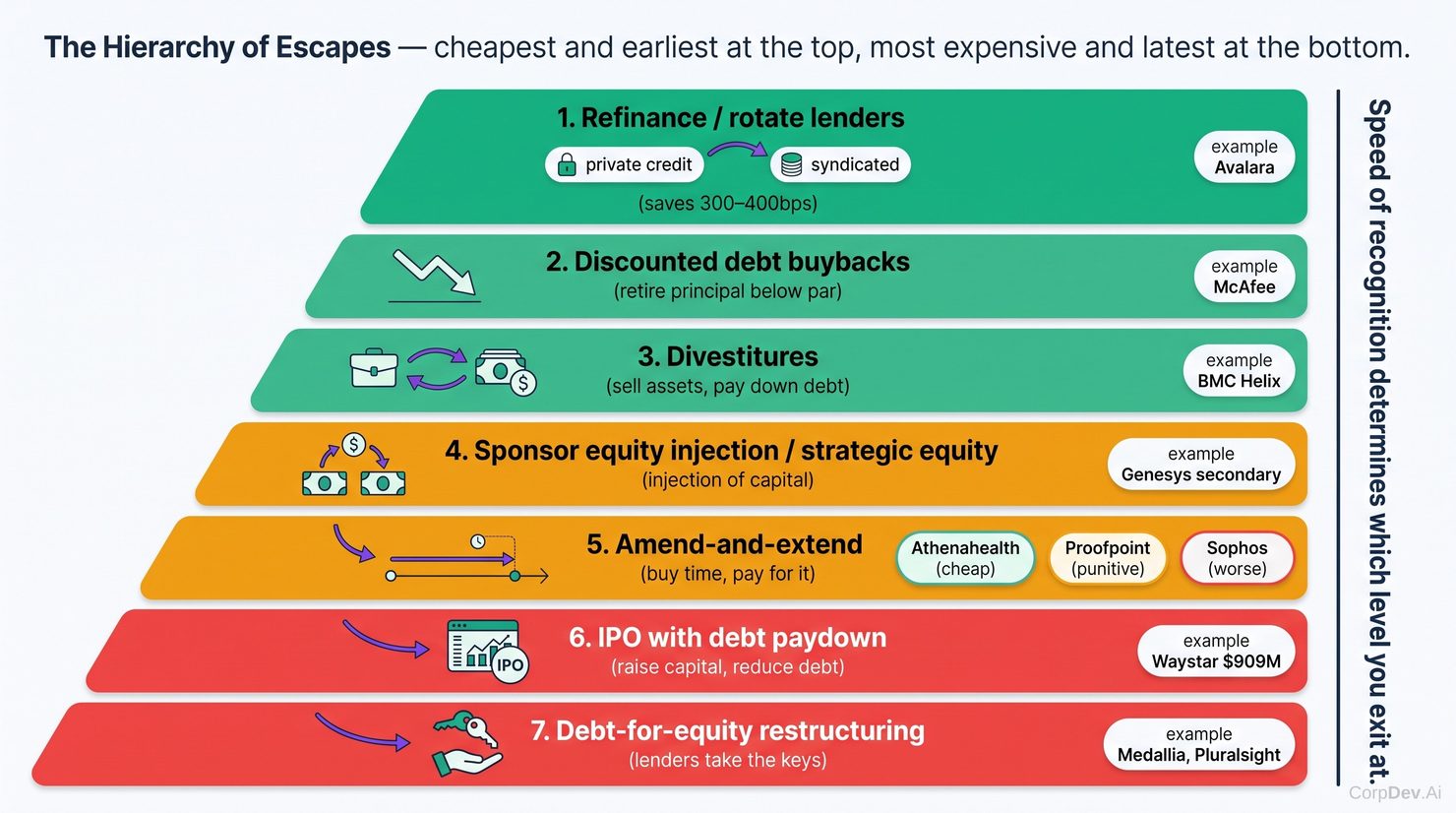
1. Refinance somewhere cheaper. Vista moved Avalara’s loan from a private lender charging 7.25% over the benchmark to the public market at 3.25% over. That’s about $100 million a year saved without putting in a penny. Do the same across KnowBe4, Duck Creek and Finastra and Vista has taken more than $200 million a year off its interest bill. The catch is that the public market only wants the good ones.
2. Buy your own debt back. McAfee spent $239 million retiring $287 million of its own loans — $48 million of debt gone for nothing. If your loans are trading in the seventies, there is no better use of company cash.
3. Sell something. KKR sold BMC’s Helix business for about $875 million and put the proceeds against the debt. The catch is the price: selling today means admitting what the thing is actually worth. Better to do it while you still have the choice.
4. Get someone else to put equity in. Salesforce and ServiceNow put $1.5 billion into Genesys. Read the fine print, though — they bought shares from existing owners, and not a penny reached the debt. It worked anyway, because it proved there was real value sitting above the loans, which now trade at 98. Useful. But it isn’t the same as paying debt down, and shouldn’t be described as though it were.
5. Ask for more time, and know what it costs. Athenahealth pushed $4.4 billion out three years on easy terms because it had performed. Proofpoint paid 9.3% and two dozen new restrictions because it hadn’t. Sophos, due in March, will pay more than either. What you’re charged for time depends almost entirely on what you did with the time you already had.
6. Go public and pay the debt down. Waystar put $909 million of its IPO proceeds straight into the debt and the loans re-rated within weeks. Everyone with a decent asset is now racing for the 2027 window, before the bad news from everybody else spoils the market.
7. Hand over the keys. Medallia, and Pluralsight before it, where about $1.3 billion of debt — three-quarters of the total — went away and Vista walked. This isn’t the playbook failing. It’s the last page of it.
What all seven have in common is dull but true: the sooner you admit the problem, the more of this list you still get to choose from. Wait, and refinancing goes first, then buybacks, then the terms for buying time turn ugly, and in the end only the seventh is left.
What I’d take from it
If you’re a sponsor, borrowing to pay yourself a dividend is finished except for the very best companies. Thoma Bravo did exactly that at Ping Identity last November, for $1.12 billion, and got away with it because Ping trades at 98. Most of the market can’t.
If you’re a lender, Medallia is the template now rather than the exception. Roughly $25 billion of these loans trade below 80 cents. That’s a queue, and it’s been demonstrated that lenders will work through it instead of extending forever.
If you’re on a board and someone wants to buy you, how the buyer intends to pay has become part of the price. An offer with $38 billion of equity behind it is worth more than a larger number resting on debt that might never materialise. Boards have watched what happens to companies trapped inside the wrong balance sheet, and I’d expect equity-backed bids to start winning even when they aren’t the highest.
We’ll end up teaching the 2021 software vintage the way we teach 2006 and 2007: what happens when cheap money meets high prices and everyone assumes the market they bought into will still be there when they want to sell. The people who bought EA, and the ones now circling Workday, have clearly read that lesson. Their answer is to pay up but build it so the company can survive being wrong about almost anything except the company itself. It’s the oldest answer there is.
It just took $5.1 billion of Thoma Bravo’s money, a 9.3% coupon on a company that never missed a payment, and $25 billion of loans below 80 cents to remind everybody.